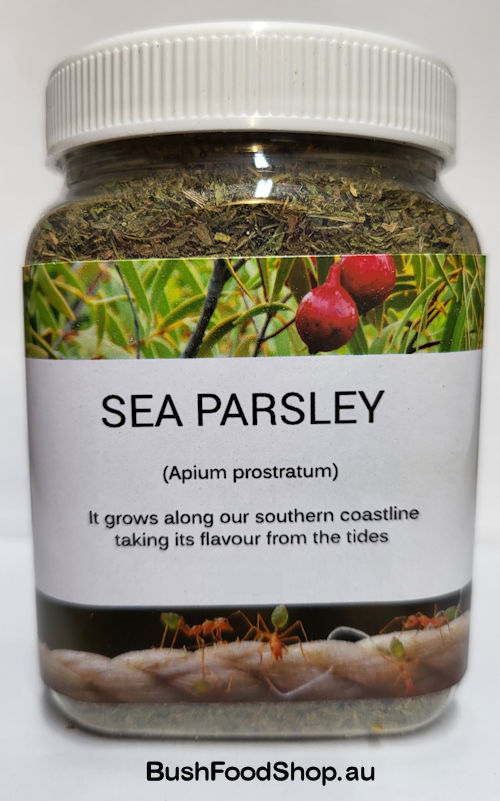

Sea Parsley – or Sea Celery, as it is sometimes called – occurs all along the southern coastline of Australia. Its leaf form and plant dimensions vary quite considerably from place to place, but most commonly it has an appearance of shiny dark green parsley, and is in fact closely related to European parsley. The significant difference is that it grows right on the coastline, often submerged by the incoming storm tides. It is the connection to the seafront, where it grows in composted sea weed and sand, that gives it its special flavour.
Sea Parsley/Celery grows in a prostrate manner over rocky ledges and sandy ridges, and its small white flower clusters give rise to large amounts of seed in the summer months.
Although an annual, Sea Parsley has a resilient tap root like a carrot, which gives it a semi-perennial capacity. It was identified by early Europeans as far back as Captain Cook in 1788, and provided a welcome flavour boost to soup and stews at the time.
It’s rich in antioxidants, particularly flavonoids like apigenin and myricetin, which may offer protection against certain diseases. Sea parsley has also been traditionally used to help prevent scurvy due to its high vitamin C content.
Captain Cook made use of this plant to prevent scurvy when “The Endeavour” visited the east coast of Australia in 1770 and it was subsequently used by early settlers as a source of greens.
This herb is useful in soups, dressings, flavoured butter, with seafood and in white sauces
Here’s a more detailed look at its potential medicinal properties:
Antioxidant and Anti-inflammatory Properties:
- Sea parsley contains significant levels of phenolic compounds and is rich in antioxidants.
- These antioxidants, including flavonoids, can help protect the body against damage from free radicals and reduce inflammation.

 Bush Food Australia
Leave a comment